
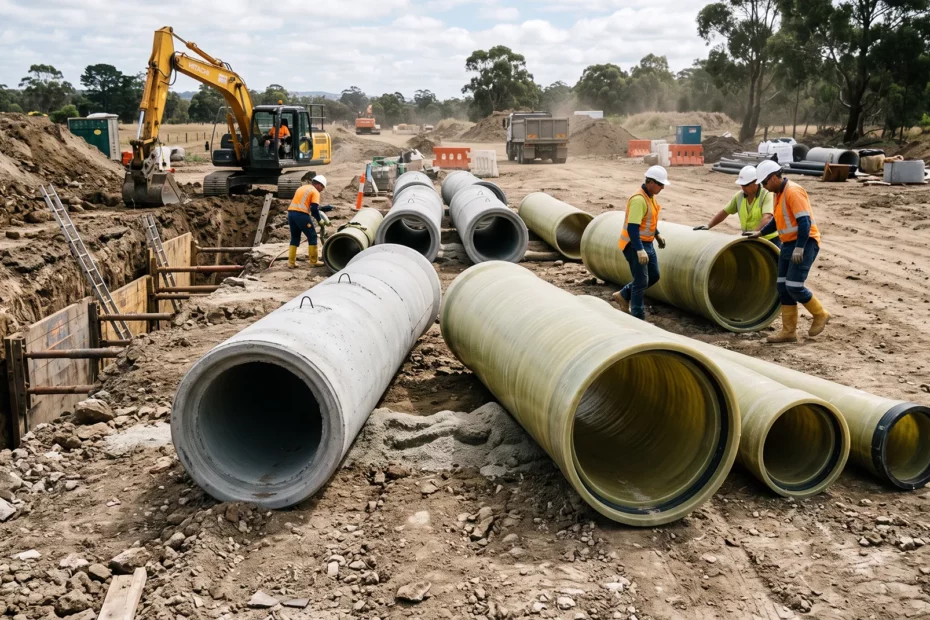
The selection of piping material is one of the key decisions during the design phase of an infrastructure project. Concrete, PVC and GRP are the three most commonly used materials in sewerage, water supply and industrial networks — each has different properties, different limitations and a different range of applications. In this article, we compare them in detail: weight, hydraulic properties, chemical resistance, service life and operating costs. No marketing-driven oversimplifications — just technical data and practical conclusions.
Why does the choice of pipe material matter?
The material used for the pipeline affects not only the purchase cost, but above all total operating costs over several decades — transport and installation costs, maintenance and cleaning costs, the risk of breakdowns, susceptibility to corrosion and aggressive waste water, and, finally, the possibility of using trenchless methods when modernising the network.
Choosing the wrong material for specific ground, chemical or hydraulic conditions may mean that the network needs to be renovated after 20 years rather than 80. Therefore, every decision regarding materials should be based on an analysis of the operating conditions, and not solely on the purchase price.
GRP pipes – technical properties and applications
GRP pipes (Glass-reinforced plastic) is a composite material combining polyester resin with glass fibre and quartz sand. It is manufactured using two main technologies: continuous filament winding (CFW) and centrifugal casting (CC).
Key properties of GRP pipes:
- Very light weight — A GRP pipe with a diameter of DN 1000 weighs approximately 85 kg/m, whilst a comparable concrete pipe can weigh as much as 625 kg/m. GRP pipes therefore weigh about 25% of the weight of concrete, which drastically reduces transport costs and simplifies installation.
- Good hydraulic properties — The Manning coefficient for GRP pipes is n = 0.009. The smooth surface minimises flow resistance and retains its properties throughout the pipe’s service life.
- Chemical resistance — GRP pipes do not corrode when exposed to aggressive waste water, H₂S or aggressive soil conditions. Depending on the resin used (orthophthalic, isophthalic or vinyl ester), the level of resistance can be tailored to specific chemical conditions.
- A wide range of diameters — from 25 mm to 4,000 mm, which allows it to be used in main collectors with large cross-sections, where PVC cannot be used.
- Service life — The design service life of Superlit GRP pipes is over 50 years, as confirmed by long-term tests in accordance with ISO 10928.
- Compatibility with trenchless technologies — GRP pipes are used in micro-tunnelling, hydraulic jacking and relining. Their high axial stiffness enables them to withstand high thrust forces during jacking operations.
Available in our range Superlit GRP pipes comply with the EN ISO 23856, ISO 10467, ISO 10639 and ASTM D3262 standards. You can find a detailed list of the standards on the website GRP standards and tests.
Concrete pipes – when are they most suitable?
Concrete is a well-established material in underground construction — it has been used for decades and is well known to contractors and designers. Modern precast concrete elements, manufactured in accordance with the PN-EN 1916 and PN-EN 1917 standards, are designed for 90–100 years of trouble-free service under appropriate conditions. However, it has specific limitations which, in many applications, rule it out as the optimal choice.
Advantages of concrete pipes:
- High resistance to temperature fluctuations
- Availability and awareness of technology in the market
- Suitable for use with very large collector diameters
- A relatively low purchase price
Limitations of concrete pipes:
- Extremely high mass — difficulties with transport and installation, the need to use heavy machinery, higher logistics costs
- Higher flow resistance — the Manning coefficient for concrete is n = 0.010–0.013, which means greater hydraulic losses than for GRP and PVC pipes
- Susceptibility to hydrogen sulphide corrosion — Concrete reacts with the H₂S present in domestic sewage, leading to the gradual degradation of the inner wall. Under such conditions, the service life of concrete pipes without protective coatings is significantly shorter than in non-corrosive environments
- Short sections — the standard length of a concrete pipe is 1 m, which means a large number of joints and a higher risk of leaks
- Limited suitability for trenchless technologies — the weight and properties of the material limit its use in relining and microtunnelling
Concrete remains a valid choice for large and very large-diameter sewers in environments with low chemical aggressiveness, particularly in stormwater and combined sewer systems.
PVC pipes – advantages and limitations
PVC (polyvinyl chloride) is the most commonly used material in gravity sewer systems and connections, particularly in single-family housing and local networks. The service life of PVC pipes under typical municipal conditions is estimated at around 50 years.
Advantages of PVC pipes:
- Lightweight and easy to install
- Good corrosion resistance under typical municipal conditions
- Low price and widespread availability
- Good hydraulic properties — Manning’s coefficient n = 0.009, comparable to GRP
- Wide availability of fittings and accessories
Limitations of PVC pipes:
- Limited diameters — PVC pipes are available up to a diameter of approximately DN 1200. For large infrastructure mains, GRP and concrete do not face this limitation
- Lower mechanical strength — at great installation depths and under road traffic loads, the required stiffness class may be difficult to achieve with PVC in larger diameters
- Limited chemical resistance — PVC is not resistant to petroleum-based solvents and certain industrial environments where vinyl ester or isophthalic resin, as used in GRP, is required
- Less suitable for jacking operations — PVC’s low axial strength limits its use in microtunnelling and hydraulic jacking
Comparison: GRP vs concrete vs PVC
| Feature | GRP | Concrete | PVC |
|---|---|---|---|
| Weight (DN 1000) | ~85 kg/m | ~625 kg/m | n/a (this diameter is not available) |
| Manning’s n | 0,009 | 0,010–0,013 | 0,009 |
| Service life | 50–100 years | 50–100 years* | around 50 years |
| Chemical resistance | High (resin selection) | Limited* | Average |
| Max. diameter | up to 4,000 mm | very large diameters | up to approx. DN 1200 |
| Trenchless technology | Yes | Limited | Limited |
| Standards | ISO, EN, ASTM | EN, PN | EN, PN |
*Concrete pipes in environments containing hydrogen sulphide (H₂S) – typical of sanitary sewer systems – degrade much more rapidly without additional protective coatings.
When should you choose GRP over concrete or PVC?
GRP is the best choice in the following situations:
Large diameters — From DN 300 upwards, GRP is lighter than concrete and offers a wider range of diameters than PVC, whilst maintaining good hydraulic properties and the ability to match the stiffness class to ground conditions.
A corrosive chemical environment — industrial effluent, high concentrations of H₂S in sanitary sewers, and acidic or alkaline environments. In such conditions, GRP with a suitable resin is the only material that guarantees a long service life without the need for costly protective coatings.
Trenchless projects — relining, microtunnelling, guided jacking. The high axial stiffness and low weight of GRP pipes make them the first choice for this type of work. You can read more about these methods in the article on trenchless technologies and GRP relining.
Restricted access to the site — city centres, historic areas, railway lines, rivers. Lightweight GRP pipes make installation easier in challenging logistical conditions and reduce project completion times.
Life-cycle costs – what really pays off?
The purchase price of GRP pipes is higher than that of PVC pipes and is often higher than that of concrete pipes. However, life-cycle cost analysis (Life Cycle Cost) changes this picture.
Transport and installation costs — A DN 1000 GRP pipe weighs less than a comparable concrete pipe by a factor of more than 7. Smaller equipment, faster installation, lower labour costs. The project completion time can be reduced by as much as 30%.
Operating costs — corrosion resistance eliminates the need for protective coatings and their renewal, which is a significant cost factor for concrete pipes operated in a hydrogen sulphide environment.
Renovation costs — With a service life of over 50 years, a GRP pipe network does not need to be replaced during a period in which a pipe network in a corrosive environment might already require costly refurbishment.
Total costs — Over the long term, GRP pipes offer cost savings of 20–40% compared with steel or concrete solutions in harsh environmental conditions, when the full life cycle is taken into account.
You can read more about the selection of pipework materials for infrastructure projects on the website inzynieria.com.
Frequently asked questions about choosing piping materials
Can GRP pipes be used for both gravity and pressure sewerage systems?
Yes. Superlit GRP pipes are available in pressure classes ranging from PN 1 (gravity) to PN 32, which means they can be used in a wide range of applications — from sewerage networks to pressurised water mains and industrial installations.
Which standards certify the quality of GRP pipes?
The Superlit GRP pipes available from Soleco comply with the EN ISO 23856, ISO 10467, ISO 10639, ISO 25780 and ASTM D3262, D3517 and D3754 standards. Each product undergoes strength, leak-tightness and chemical resistance tests in accordance with the requirements of these standards.
Are GRP pipes suitable for industrial applications involving corrosive media?
Yes — the appropriate resin is selected depending on the type of medium. Orthophthalic resin is suitable for typical municipal conditions, whilst isophthalic and vinyl ester resins are suitable for environments with increased chemical aggressiveness, such as chemical plants or the power industry.
How does GRP compare to PVC in terms of hydraulics?
GRP and PVC have comparable hydraulic properties — the Manning’s coefficient for both materials is n = 0.009. GRP’s clear hydraulic advantage is evident when compared with concrete (n = 0.010–0.013). GRP’s advantage over PVC stems primarily from the range of available diameters, its mechanical strength and its chemical resistance.
Where can I get technical support when selecting GRP pipes for a specific project?
Soleco offers project support for design offices and contractors — from the selection of technical specifications, through the preparation of documentation, to support during the implementation phase. Contact us, to discuss the requirements for your investment.