
Centrifugal casting (CC) - an advanced manufacturing technology for GRP pipes
Process centrifugal casting of GRP ensures the highest precision and durability of the pipes through the use of automated computer systems and full control over the structure of the layers. This technology allows the production of pressure and non-pressure pipes with excellent mechanical properties and chemical resistance.
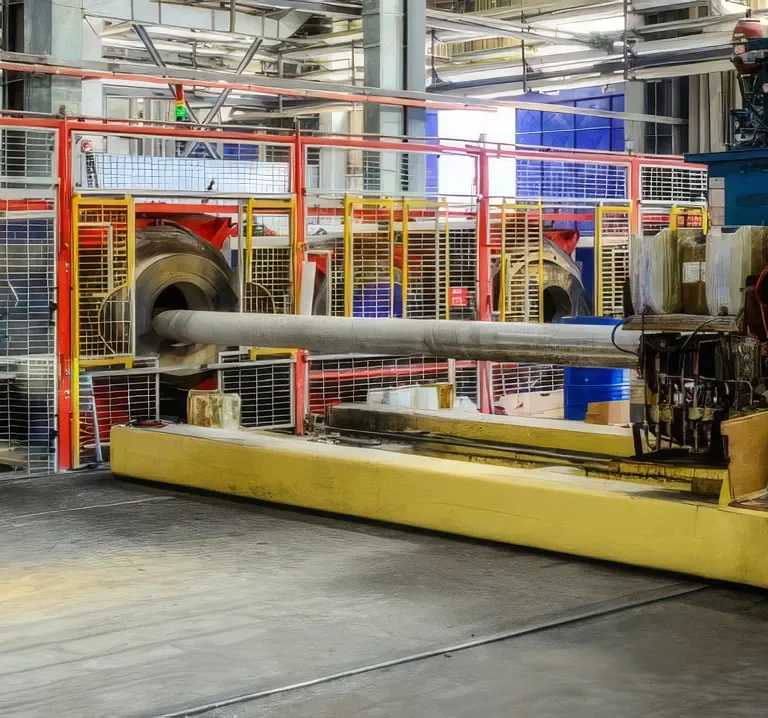
What sets the technology apart centrifugal casting of GRP pipes?
Thanks to state-of-the-art computer systems, process centrifugal casting (CC) used by the company SUPERLIT allows precise control of the consumption and distribution of raw materials during GRP pipe production. Once the pipe grade and diameter are entered into the computer system, every action - from preparing the raw material to removing the finished pipe from the mould - is precisely controlled.
Optimised parameters guarantee high quality, traceability and design compliance.
Automated GRP production - full control from start to finish
GRP pipes manufactured by Centrifugal casting arise from polyester resin, glass fibre i quartz sand.
In this fully automated process, raw materials are fed into the rotating mould, starting from the outer layer of the pipe. Thanks to continuous electronic monitoring, the following are controlled:
amount of raw material,
mould speed,
number of layers,
temperature inside the mould.
The special feeder head introduces accurately measured raw material - resin and fibre - into the mould. Fibre distribution is monitored to ensure uniform properties in axial and circumferential directions.
Once the material dispensing is complete, the mould increases the speed of rotation, which strengthens the walls and ensures the right material density. Laminating takes place layer by layer to achieve the desired wall thickness.
The process ends material curing and automatic removal of the finished product of form.
Multi-layer structure for maximum durability and resistance
Each GRP pipe manufactured using the CC method has a a precisely designed layered structure, responsible for:
mechanical strength,
chemical resistance,
abrasion and UV resistance.
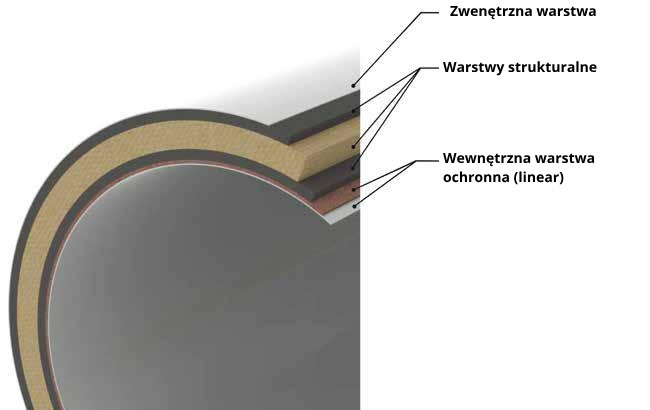
Individual layers of pipe:
Inner layer - made of pure polyester, vinylester or PU resin. Provides hydraulic properties and abrasion resistance. Thickness min. 1 mm.
Barrier layer - Together with the lining, it protects against the penetration of chemicals into the structural layers.
Structural layer - contains glass fibre, resin and quartz sand, providing appropriate stiffness and pressure class.
Outer layer - protects against mechanical and UV damage.
Through the use of different cutting knives and mould settings, each layer has a well-defined function, which translates into design flexibility and reliability under difficult operating conditions.
Video - centrifugal casting of GRP pipes in practice
See what it looks like production of GRP pipes by centrifugal casting (CC). In the gallery, we present video footage of the process that guarantees highest quality, precision and durability of products SUPERLIT.